
Nio Inc (NYSE: NIO) and Contemporary Amperex Technology Co. Limited (CATL) (HKG: 3750) (SHE: 300750) have signed a new five-year strategic agreement aimed at deepening cooperation on long-life batteries and battery swap infrastructure, as China’s largest battery maker prepares to roll out sodium-ion batteries at scale by the end of 2026.
The deal formalizes cooperation across battery technology, ecosystem development, and market expansion within China’s fast-evolving new energy vehicle sector.
CATL said the partnership is designed to accelerate technological progress while encouraging new business models. Furthermore, the company framed the agreement as support for Hefei’s ambition to build a world-class NEV industrial cluster anchored by manufacturing, research, and supply-chain depth.
Technologically, the two companies plan to co-develop long-life battery systems and battery swap compatibility solutions. In addition, the collaboration will prioritize deploying new technologies quickly across multiple battery chemistries rather than relying on a single technical route.
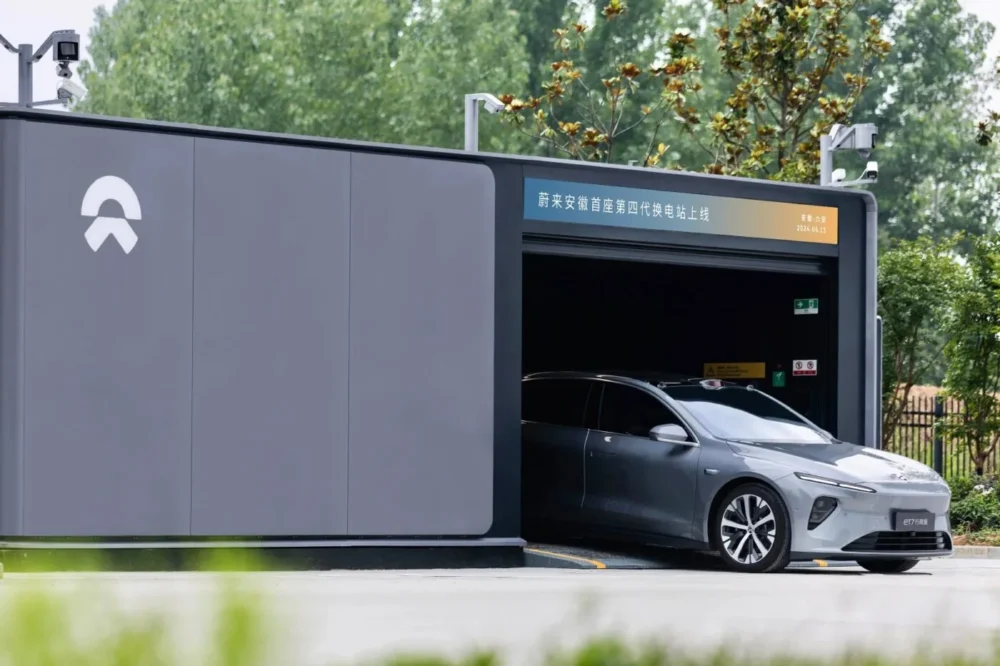
Both firms also intend to work toward standardizing battery swap systems. Additionally, they plan to share network resources to improve utilization rates and lower costs across Nio’s growing swap infrastructure.
The companies said ecosystem development will focus on Battery as a Service models. Furthermore, CATL and Nio aim to promote an open, shared battery swap framework that other automakers and partners can eventually access.
Market expansion forms the third pillar of the agreement. Meanwhile, the companies plan joint branding efforts at home and abroad, seeking to boost their global visibility in electric mobility.
Read more: Albemarle sells refining catalyst units as lithium supply glut persists
Read more: American Battery Tech stock slides after loss of US$58M DOE grant
CATL’s role in Nio’s supply chain strengthening
CATL described the partnership as a shift toward deeper ecosystem alignment. Consequently, the company said a long-term cooperative framework will help both parties navigate structural change in the auto industry while delivering safer and more efficient electric vehicles.
The agreement also reflects Nio’s increasing reliance on CATL for battery supply. However, that reliance has evolved as Nio experimented with multiple suppliers in recent years.
On December 27, local outlet 36Kr reported that Nio suspended battery procurement from BYD (OTCMKTS: BYDDY) unit FinDreams Battery for its Onvo L60 midsize SUV. Additionally, the report said order volumes were too low to justify maintaining several battery suppliers.
The same report indicated that some 100-kilowatt-hour battery packs previously sourced from CALB have since shifted back to CATL. Subsequently, CATL’s role within Nio’s supply chain appears to be strengthening again.
Nio relied exclusively on CATL for battery supply during much of its early growth. However, the automaker later diversified sourcing as competition intensified and battery technologies multiplied.
The two companies had already laid groundwork for deeper collaboration. In March 2024, they agreed to jointly develop long-life batteries, and in March 2025 they announced plans to build what they described as the world’s largest battery swap network.
Meanwhile, Nio marked a manufacturing milestone earlier today by rolling out its one-millionth mass-produced vehicle from its F2 factory in Hefei. The milestone reinforced the city’s role as a core production base for China’s electric vehicle industry.
CATL enters this expanded partnership from a position of global dominance. Through October, the company controlled 38.1 per cent of the global EV battery market in 2025, according to SNE Research. That figure rose slightly from 37.6 per cent in 2024.
Read more: Ford backs away from electric-vehicle plans as demand chills
Read more: Lithium-ion battery market set to double by 2030
CATL positioning sodium-ion batteries as growth lever
China’s BYD ranked second with a 16.9 per cent market share. Additionally, LG Energy Solution followed with 9.3 per cent, while CALB held 4.7 per cent and Gotion High-Tech accounted for 4.1 per cent.
CATL is now positioning sodium-ion batteries as its next major growth lever. During a supplier conference on December 28, 2025, the company confirmed that sodium-ion technology will be ready for large-scale deployment by the end of 2026.
The company said sodium-ion batteries will be used across battery swapping, passenger vehicles, commercial fleets, and stationary energy storage. Furthermore, CATL framed the rollout as a way to reduce dependence on lithium supply chains.
In April, CATL introduced Naxtra, its sodium-ion battery brand. Additionally, the company said Naxtra cells reach an energy density of 175 watt-hours per kilogram, placing them near some lithium iron phosphate batteries.
Like LFP batteries, sodium-ion chemistry promises lower costs. However, CATL claims sodium-ion batteries deliver improved safety and stronger performance in cold climates.
CATL has previously said sodium-ion technology can extend driving range and enable faster charging in winter conditions. Furthermore, the company said its commercial sodium-ion cells operate between minus 40 degrees Celsius and 70 degrees Celsius.
In September, CATL stated that vehicles equipped with the new batteries can achieve pure electric driving ranges exceeding 500 kilometers, or about 310 miles. Consequently, the company said the technology is already prepared for scaled deployment.
Naxtra sodium-ion batteries were also the first to pass China’s updated EV battery safety rules, known as GB 38031-2025. Those standards take effect on July 1, 2026.
.