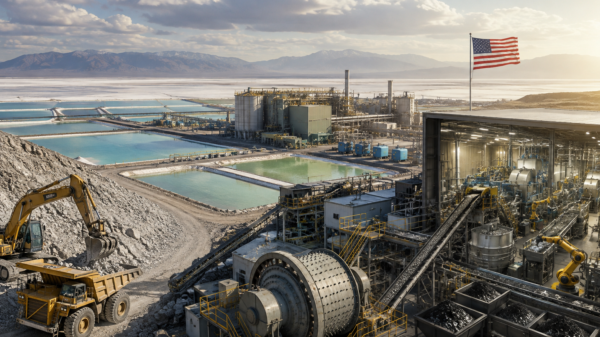

The global drive toward a clean energy future and advanced security technologies now depends on a handful of obscure minerals. A small group of rare earth and critical mineral resources powers electric vehicles, wind turbines, batteries, and defense systems. When mining, refining and magnet making remain concentrated mostly in one country, supply becomes fragile. That fragility threatens the “green shift” by slowing deployment of EVs, clean energy infrastructure and grid upgrades. It also threatens national security. Without reliable access to rare earths, countries may struggle to build advanced jets, drones, radar systems and high tech weapons.
Governments and industries in the West increasingly view this as a strategic vulnerability rather than a standard commodity risk. In the past year, export controls from a dominant supplier rattled global supply chains. OEMs, automakers and clean energy firms felt the squeeze. Many began re evaluating their dependence on a few suppliers. Meanwhile, new mining and refining projects outside the traditional supplier nation have gained support. Those projects promise, at least in theory, to reinstate supply diversity and reduce geopolitical leverage over critical industries.
As the world decarbonizes and modernizes militaries, the race for secure mineral supply chains becomes a pivotal front. The stakes now extend beyond economics and into energy independence, industrial resilience and national defence.
Here are five companies to look for in 2026 as this story continues.
Perpetua Resources (Antimony + Gold)
Perpetua Resources (NASDAQ: PPTA) (TSE: PPTA) is developing the Stibnite Gold Project in Idaho and aims to become the first major U.S. antimony producer in decades. Antimony is a strategic mineral used in flame retardants, batteries, and military hardware, and the U.S. has long depended on imports, mostly from China. The Stibnite Project also contains gold and is expected to provide roughly 35 per cent of U.S. antimony demand during its first six years of operation.
Perpetua has received key regulatory approvals and met financing milestones that indicate the project is advancing as planned. In addition, U.S. government efforts to secure domestic critical mineral supply offer a supportive policy environment. One regulatory tool is the FAST 41 program, a federal permitting initiative created under the Fixing America’s Surface Transportation Act. FAST 41 coordinates environmental reviews and approvals for major infrastructure, including mining, processing, and recycling projects. By establishing timelines, improving interagency coordination, and offering public transparency through the Federal Permitting Dashboard, FAST 41 helps reduce delays and uncertainty.
For Perpetua, this program could accelerate federal permits, enhance investor confidence, and lower regulatory risk. Furthermore, Stibnite offers exposure to both gold, appealing to traditional commodity investors, and antimony, which serves strategic and industrial markets. Investors and analysts are watching closely to see if the project can produce reliably at scale, given the environmental and permitting challenges typical of U.S. based mines.
Read more: NevGold expands high-grade antimony discovery at Nevada’s Limousine Butte Project
Read more: NevGold delivers major growth at Idaho gold project
UCore Rare Metals (Rare Earth Elements)
UCore Rare Metals (CVE: UCU) (OTCMKTS: UURAF) is a small but strategically positioned player in rare earth elements (REEs), a sector dominated by China.
Its Bokan Dotson Ridge Project in Alaska focuses on heavy REEs. Meanwhile UCore’s planned processing complex in Louisiana aims to produce separated REEs domestically, addressing a significant supply chain bottleneck.
Rare earths are essential for electronics, renewable energy systems, and defense technologies. These make UCore an attractive prospect for both investors and policymakers seeking to reduce reliance on foreign sources.
One of the biggest selling points for a company like Ucore is that it has its own proprietary separation tech.
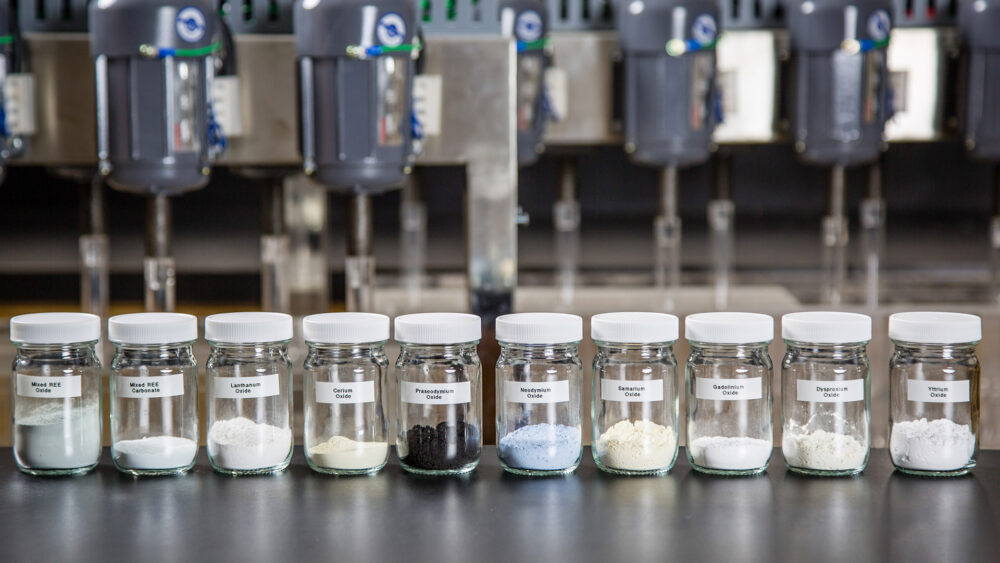
RapidSX is UCore’s patented, column based, solvent extraction separation platform, designed to refine mixed rare earth concentrates into individual rare earth oxides (REOs). These typically include both light (LREE) and heavy (HREE) in a single, integrated process.
Compared with traditional vat based solvent extraction methods, RapidSX can be approximately three times more effective while requiring roughly one third the processing plant footprint. It has also approximately 20 to 50 per cent lower capital and operating costs.
UCore has built a 52 stage demonstration plant in Kingston, Ontario, which runs thousands of hours to refine mixed REE feedstocks. Furthermore, it is now scaling the technology to its planned commercial facility in Louisiana. If successful, RapidSX could enable a more efficient, lower cost, and environmentally cleaner rare earth supply chain outside of China.
The company’s strategy is to vertically integrate mining and processing, potentially lowering costs and mitigating geopolitical risk. However, execution risk remains, as UCore must navigate permitting, technical processing challenges, and financing hurdles. If successful, UCore could become a critical component of the North American rare earth supply chain, providing leverage in a market where demand is set to rise sharply through the 2020s.
Lithium Americas (Lithium)
Lithium Americas (NYSE: LAC) (TSE: LAC) is developing lithium projects in North and South America, including the Thacker Pass mine in Nevada and the Caucharí Olaroz project in Argentina.
Despite recent supply issues, lithium remains a cornerstone of the global electric vehicle (EV) and energy storage revolution. It also has a demand projected to grow rapidly as EV adoption accelerates. Lithium Americas aims to capitalize on this surge, targeting both high volume and high purity lithium production.
Its North American projects benefit from proximity to EV battery manufacturers and strong policy incentives supporting domestic production. The company faces typical mining and permitting challenges, but successful development could secure a share of the U.S. lithium market.
Investors watch Lithium Americas for its ability to scale production efficiently, manage costs, and meet sustainability standards. Especially given the growing emphasis on environmentally responsible mining.
The only real downside is that the the global lithium market has been oversupplied in recent years. This has worked to slow demand especially amid a softer than expected EV boom. As a result, it’s pushed prices sharply lower. Analysts now expect that oversupply to shrink: production cuts and reduced output from marginal mines should help the surplus fall from roughly 150,000 t LCE in 2024 to about 80,000 t in 2025, with some forecasts projecting a mild supply deficit by 2026.
That creates a window of opportunity: companies buying lithium miners or project exposure while valuations are depressed may stand to benefit as demand recovers, driven by electric vehicle growth, energy storage rollout, and an impending supply demand rebalancing.
NevGold Corp. (Speculative Explorer)
NevGold Corp (CVE: NAU) (OTCMKTS: NAUFF) (FRA: 5E50) represents a higher risk, higher reward segment of the critical minerals market. As a junior exploration company, NevGold targets deposits that could yield antimony, gold, or other critical metals. While the company lacks the operational scale of Perpetua or Lithium Americas, its exploration projects provide optionality. For example, if a discovery proves commercially viable, early investors could see substantial gains.
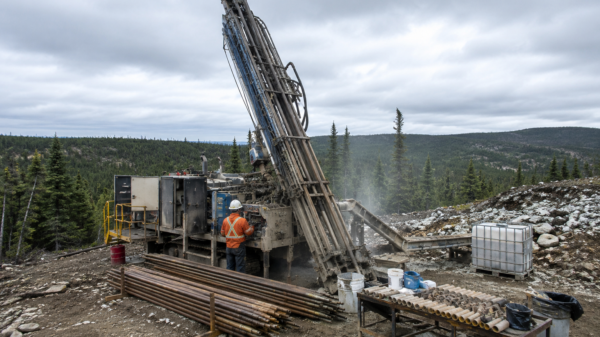
The company’s strategy focuses on underexplored regions, leveraging geological data and targeted drilling programs to identify promising mineralization. The company is also well positioned to benefit from potential partnerships or acquisitions by larger miners seeking to expand their portfolios.
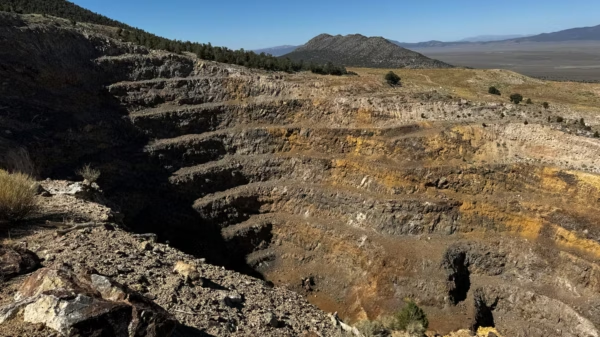
NevGold’s 2025 work at Limousine Butte delivered encouraging antimony milestones. Metallurgical testing on oxide gold antimony material showed antimony recovery of up to 92 per cent. Furthermore, this discovery had minimal impact on gold recoveries. This suggests antimony could be economically extracted directly on site rather than relying on third party smelters.
Furthermore, concurrent drilling returned consistently broad zones of gold antimony mineralization: for example, one hole hit 2.11 g/t gold equivalent over 67.1 m (with ~0.18 per cent Sb), including a 5.05 g/t Au over 16.8 m interval with approximately 0.46 per cent Sb.
Meanwhile, historical surface sampling also revealed rock chips with as much as 10 per cent antimony — underscoring potential high grade Sb zones.
Taken together, these results strengthen the case that Limousine Butte could become a dual commodity mine, giving NevGold exposure to critical mineral upside beyond traditional gold.
Risk is inherent, given exploration stage uncertainties, capital requirements, and commodity price fluctuations. Nevertheless, NevGold exemplifies the speculative side of the critical minerals sector.
Read more: NevGold targets U.S. critical mineral supply chain with new antimony-gold find
Read more: NevGold Expands Gold-Antimony Potential at Limousine Butte in Nevada
NioCorp Developments Ltd. (Niobium, Rare Earths)
NioCorp’s (NASDAQ: NIOBW) Elk Creek Critical Minerals Project in Nebraska aims to produce niobium, scandium, titanium, and rare earth elements from a single integrated operation. The project has garnered government attention, including a USD$10 million grant under the Defense Production Act to support domestic scandium supply, reflecting its strategic significance.
NioCorp seeks to address multiple mineral shortages simultaneously, making it a rare multi commodity play in the U.S. The company has completed feasibility studies and continues to pursue financing and permitting milestones.
Niobium is primarily used in high strength, low alloy steels, which are critical for aircraft, naval vessels, armoured vehicles, and pipelines. It provides strength, ductility, and corrosion resistance while reducing weight.
Further, scandium is a lightweight alloying agent that improves aluminum strength and weldability, enabling stronger, lighter airframes, missile components, and spacecraft structures.
Finally, titanium is essential for jet engines, aerospace frames, and naval ships due to its strength to weight ratio and corrosion resistance.
Beyond defense, all three metals have industrial and clean energy uses: niobium in superconducting magnets, scandium in fuel cell and battery alloys, and titanium in chemical processing, medical implants, and renewable energy infrastructure. Elk Creek’s potential to supply these materials domestically addresses U.S. strategic supply vulnerabilities.
If operational, Elk Creek could become a cornerstone of North America’s critical minerals infrastructure. It could do so by supplying metals vital to aerospace, defense, clean energy, and battery applications.
.
NevGold Corp is a sponsor of Mugglehead news coverage
.